Quilt
- Description
- Handmade memorial quilt created in memory of Francis John Sadocha and gifted to his family. The quilt is made with red, white, and blue-patterned fabrics and has several quilt squares using clothing belonging to Sadocha as well as photo transfers and small patches representing some of his interests. "Frankie" is sewn toward the top and "May 3, 1960 | September 11, 2001" is sewn in the middle below a photo transfer image of Sadocha with his two young daughters.
On The back of the quilt is a small American flag with handwritten text on the stripes: "Designed and sewn by Keats Scott with the help of The Sew and Sews: Janet Schayer, Lorraine Caposole, Linda Swanson, Laverne Rotello, and Reneta Lucas, in Heeney, Colorado in 2002." - Historical Notes
- Rockville Centre, Long Island, native Francis Sadocha lived in Huntington with his wife, Nancy, and their two young daughters. He was a manager at Forte Food, Cantor Fitzgerald’s food service provider. He also did catering for a local synagogue and was preparing to open his own restaurant. On September 11, Francis was at Cantor training new managers on the North Tower’s 101st floor. He was 41 years old.
Curator's Comment
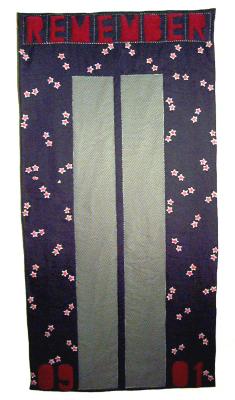
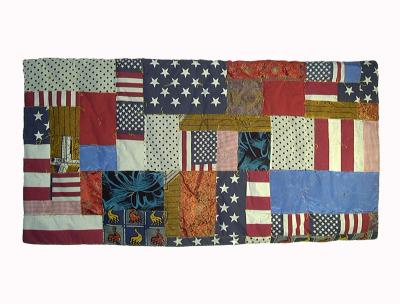
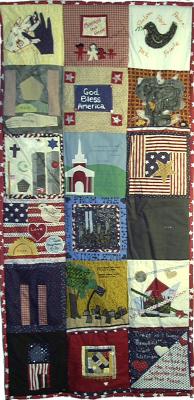
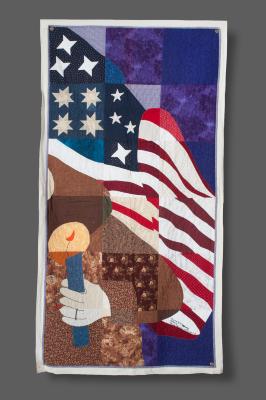
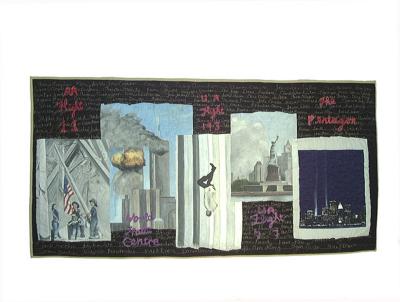
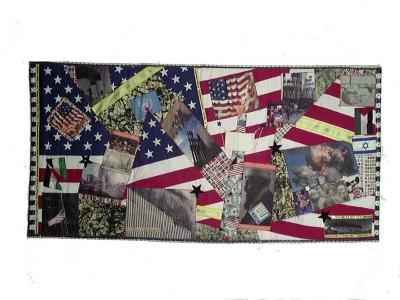
The terrorist attacks of September 11, 2001, ignited a global passion to provide aid and comfort. For those unable to participate in actual rescue and recovery efforts at the various disaster sites, quilting emerged as one practical and creative way to demonstrate compassion and support for 9/11 family members, responders, survivors, and others who were profoundly affected by the attacks.
Traditionally the outcome of either communal or solitary cutting, piecing, and sewing efforts, quilts are both functional and tactile expressions of their makers’ emotions, ideas, and materials at hand that could be recruited into meaningful service. Those drawn to making quilts in response to 9/11 frequently used patriotic motifs, religious symbols, and images that quickly became emblematic of the attacks, such as the Twin Towers, the 5-sided Pentagon, airplanes, and firefighting paraphernalia. Some quilts served as memorial gestures in honor of specific individuals or groups of coworkers who had been killed while also performing therapeutic and healing functions for those making them. Communication of the magnitude of human loss suffered on 9/11 and the event’s disproportionate impact on particular companies, agencies, towns, and colleges are other themes that emerged among quilters.
Traditionally the outcome of either communal or solitary cutting, piecing, and sewing efforts, quilts are both functional and tactile expressions of their makers’ emotions, ideas, and materials at hand that could be recruited into meaningful service. Those drawn to making quilts in response to 9/11 frequently used patriotic motifs, religious symbols, and images that quickly became emblematic of the attacks, such as the Twin Towers, the 5-sided Pentagon, airplanes, and firefighting paraphernalia. Some quilts served as memorial gestures in honor of specific individuals or groups of coworkers who had been killed while also performing therapeutic and healing functions for those making them. Communication of the magnitude of human loss suffered on 9/11 and the event’s disproportionate impact on particular companies, agencies, towns, and colleges are other themes that emerged among quilters.
- Accession Number: C.2011.734.1
- Dimensions: 89 in X 78 in X 0.375 in
- Dimensions (Metric): 226.06 cm X 198.12 cm X 0.9525 cm
- Source: Susan Sadocha
- Credit Line: Gift of Norma and Susan Sadocha, in memory of their son and brother, Francis
All materials made publicly available by the 9/11 Memorial & Museum on this site are intended for research and educational use only. Users may need to obtain other permissions for their intended use(s) and are responsible for determining copyright status and securing these permissions.
To inquire about copyrights and reproductions, contact: xxx@911memorial.org