Photograph, Print
Marek Truskolaski, Raul Pala and Julio Jalil, Asbestos Handlers, Laborers' International Union of North America, Local 78
- Description
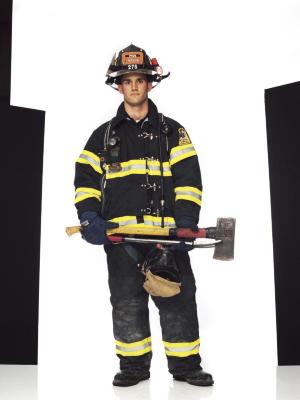
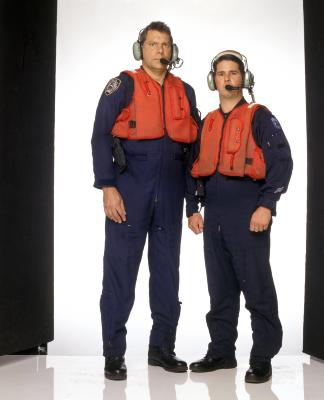
- Life-sized Polaroid photograph taken by Joe McNally depicting asbestos handlers Marek Truskolaski, Raul Pala and Julio Jalil. All three of the men are wearing white Tyvek suits; dirtied, yellow latex gloves; hard hats; and respirators. Truskolaski and Jalil have duct tape wrapped around their shoes.
- Historical Notes
- When the Twin Towers collapsed, releasing at least 400 tons of asbestos into the environment, licensed asbestos abatement professionals became essential to the city's response and recovery. The presence of asbestos in the environment posed a known health risk for first responders, students, workers, and residents throughout lower Manhattan. Long before 9/11, the Environmental Protection Agency had concluded that there is no safe level of asbestos exposure for humans. The EPA considers any product containing at least one percent asbestos to be an "asbestos-containing material." In the wake of the terrorist attacks, this concern extended to residual material from the collapsed buildings.
Asbestos sampling was required to determine how far and at what levels the toxin had spread environmentally. The sampling process established which spaces in lower Manhattan required abatement. The EPA began sampling for the presence of asbestos in "dust" on September 11. Sampling for asbestos traces in ambient air began on September 12. Over the subsequent days and weeks, other government agencies and private citizens began collecting their own test samples. The results varied, as did official guidance on removal. What remained true was that the most safe and efficient strategy for removing asbestos was to employ licensed, properly equipped asbestos and hazardous waste disposal professionals to remove any suspected contaminants. Professional handlers such as those belonging to Laborers Local 78 were crucial to the task of making lower Manhattan safe again.
Marek Truskolaski, Raul Pala, and Julio Jalil, members of Local 78, began their World Trade Center cleanup efforts on September 15. Coworkers remarked about encountering adjacent buildings with interior surfaces covered in thick dust. It was the scale of human loss measured in the scope of destruction at Ground Zero that shocked Truskolaski. He told McNally, "I was crying, thinking about the people who died and their families." Jalil added, "It would take the devil to kill so many people."
Curator's Comment
In the weeks after September 11, LIFE Magazine photographer Joe McNally (b. 1952) invited rescuers, recovery workers, survivors, and bereaved family members to a studio in Manhattan’s Bowery district, not far from Ground Zero. Here, the participants were memorialized by a unique Polaroid camera—dubbed the Moby C—equipped with a lens from a U-2 spy plane. This room-sized instrument could capture an exposure of singular clarity on an eight-foot tall piece of film in the blackened studio. Each 90-second session required meticulous staging and absolute stillness. Whereas most photographers were concentrating on documenting the devastation of the attacks downtown, McNally was interested in recording the heroism and sorrow etched into the human faces at the center of this national tragedy. Those who faced the camera were mostly everyday people who sought no special recognition. “They came only with the intention of participating in a project, telling their story, and sharing in the telling of others,” McNally reflected.
The 9/11 Memorial Museum has enjoyed a long relationship with McNally's images. In 2006, McNally donated his portrait of FDNY Ladder 20 firefighter Adrienne Walsh to support the Museum’s nascent permanent collection. When the outdoor Memorial opened to the public in 2011, a selection from the series was borrowed from the photographer and rotated onto view in the temporary Visitor Center at 90 West Street. Annual acquisitions from the Faces of Ground Zero archive have continued, often as gifts arranged by McNally. In 2017, the Museum assumed custody of the remaining Polaroids in an agreement that will result in the collection’s completed donation by 2027.
The image in this record is the product of a color transparency from a Mamiya RZ 6x7 Pro II 120 format camera that McNally positioned to record a shot simultaneous with the Polaroid Moby C’s flash of light. The unique, original Polaroid exhibits a more subtle and creamier tonality.
The 9/11 Memorial Museum has enjoyed a long relationship with McNally's images. In 2006, McNally donated his portrait of FDNY Ladder 20 firefighter Adrienne Walsh to support the Museum’s nascent permanent collection. When the outdoor Memorial opened to the public in 2011, a selection from the series was borrowed from the photographer and rotated onto view in the temporary Visitor Center at 90 West Street. Annual acquisitions from the Faces of Ground Zero archive have continued, often as gifts arranged by McNally. In 2017, the Museum assumed custody of the remaining Polaroids in an agreement that will result in the collection’s completed donation by 2027.
The image in this record is the product of a color transparency from a Mamiya RZ 6x7 Pro II 120 format camera that McNally positioned to record a shot simultaneous with the Polaroid Moby C’s flash of light. The unique, original Polaroid exhibits a more subtle and creamier tonality.
- Accession Number: C.2013.644.8
- Dimensions: 109 in X 44 in X 0.08 in
- Dimensions (Metric): 276.86 cm X 111.76 cm X 0.2032 cm
- Source: Joseph McNally
- Credit Line: Gift of Joe McNally in thanks for ADORAMA's ongoing generous support of the Faces of Ground Zero Collection and of the "Faces of Ground Zero - 10 Years Later" Exhibit, 2011. Courtesy, Ellen Price, Inc. © Joe McNally.
Ground ZeroHealth EffectsLaborers Photographer and Videographer: ProfessionalRescue and RecoveryWorld Trade Center: Dust
All materials made publicly available by the 9/11 Memorial & Museum on this site are intended for research and educational use only. Users may need to obtain other permissions for their intended use(s) and are responsible for determining copyright status and securing these permissions.
To inquire about copyrights and reproductions, contact: xxx@911memorial.org