Photograph, Print
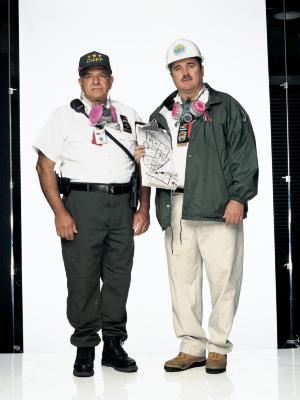
Christopher Pepe, David Kravette, Salesman and Managing Director, Cantor Fitzgerald
- Description
- Life-sized Polaroid photograph taken by Joe McNally depicting Cantor Fitzgerald survivors Christopher Pepe and David Kravette. Both men are wearing dress pants and button-up shirts.
- Historical Notes
- On September 11, 2001, Cantor-Fitzgerald—headquartered at the top of the North Tower—suffered the inconceivable loss of 658 of the firm’s employees and contractors, a loss representing over half of its workforce. Those spared death that Tuesday morning were either out sick, on vacation, or protected by the vagaries of fate. Among the few survivors were David Kravette and Christopher Pepe.
David Kravette, a veteran with Cantor Fitzgerald who served as one of its managing directors, reported as usual to his 105th floor office on the morning of 9/11. Minutes before 8:46 a.m., Kravette learned that the business clients he was expecting for a meeting had neglected to bring along their proper identification and were in the building’s lobby, waiting for a company escort. Instead of sending his pregnant secretary to retrieve the guests, he decided to go himself and caught an elevator down to the lobby. Just after he arrived there, he remembered hearing elevators falling and crashing, followed by a huge explosion, releasing a fireball out of the elevator banks. Kravette and his clients managed to escape from the building. He later walked uptown to seek shelter with relatives. Acknowledging that survivor’s guilt plagued him, he nonetheless found consolation in helping to re-establish the firm and build back its profitability to a level that would enable Cantor Fitzgerald to provide for the families of its 658 victims.
On 9/11, Christopher Pepe served as head of sales for the bond firm at Cantor Fitzgerald. He might have been among the day’s death statistics had he not been summoned by phone at the last minute to a previously unscheduled meeting at Goldman Sachs. Pepe left the North Tower before 8:30 a.m. to walk over to Broad Street and consequently was not in his office at 8:46 a.m. when hijacked Flight 11 slammed into the building. Like Kravette Pepe stayed with the firm in the attack's aftermath to address the crisis and help rebuild the company.
David Kravette donated his Cantor Fitzgerald business card and his WTC parking pass to the collection.
Curator's Comment
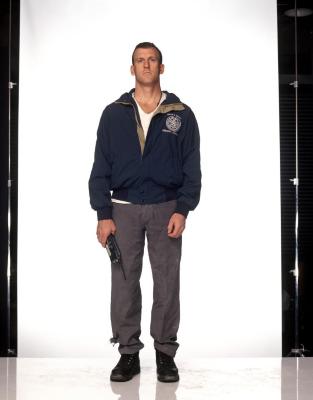
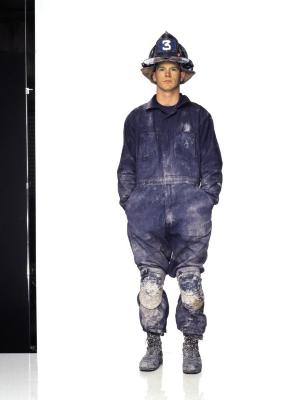
In the weeks after September 11, LIFE Magazine photographer Joe McNally (b. 1952) invited rescuers, recovery workers, survivors, and bereaved family members to a studio in Manhattan’s Bowery district, not far from Ground Zero. Here, the participants were memorialized by a unique Polaroid camera—dubbed the Moby C—equipped with a lens from a U-2 spy plane. This room-sized instrument could capture an exposure of singular clarity on an eight-foot tall piece of film in the blackened studio. Each 90-second session required meticulous staging and absolute stillness. Whereas most photographers were concentrating on documenting the devastation of the attacks downtown, McNally was interested in recording the heroism and sorrow etched into the human faces at the center of this national tragedy. Those who faced the camera were mostly everyday people who sought no special recognition. “They came only with the intention of participating in a project, telling their story, and sharing in the telling of others,” McNally reflected.
The 9/11 Memorial Museum has enjoyed a long relationship with McNally's images. In 2006, McNally donated his portrait of FDNY Ladder 20 firefighter Adrienne Walsh to support the Museum’s nascent permanent collection. When the outdoor Memorial opened to the public in 2011, a selection from the series was borrowed from the photographer and rotated onto view in the temporary Visitor Center at 90 West Street. Annual acquisitions from the Faces of Ground Zero archive have continued, often as gifts arranged by McNally. In 2017, the Museum assumed custody of the remaining Polaroids in an agreement that will result in the collection’s completed donation by 2027.
The image in this record is the product of a color transparency from a Mamiya RZ 6x7 Pro II 120 format camera that McNally positioned to record a shot simultaneous with the Polaroid Moby C’s flash of light. The unique, original Polaroid exhibits a more subtle and creamier tonality.
The 9/11 Memorial Museum has enjoyed a long relationship with McNally's images. In 2006, McNally donated his portrait of FDNY Ladder 20 firefighter Adrienne Walsh to support the Museum’s nascent permanent collection. When the outdoor Memorial opened to the public in 2011, a selection from the series was borrowed from the photographer and rotated onto view in the temporary Visitor Center at 90 West Street. Annual acquisitions from the Faces of Ground Zero archive have continued, often as gifts arranged by McNally. In 2017, the Museum assumed custody of the remaining Polaroids in an agreement that will result in the collection’s completed donation by 2027.
The image in this record is the product of a color transparency from a Mamiya RZ 6x7 Pro II 120 format camera that McNally positioned to record a shot simultaneous with the Polaroid Moby C’s flash of light. The unique, original Polaroid exhibits a more subtle and creamier tonality.
- Accession Number: C.2018.163.1
- Dimensions: 109 in X 44 in X 0.08 in
- Dimensions (Metric): 276.86 cm X 111.76 cm X 0.2032 cm
- Source: Joseph McNally
- Credit Line: Collection 9/11 Memorial Museum. © Joe McNally.
All materials made publicly available by the 9/11 Memorial & Museum on this site are intended for research and educational use only. Users may need to obtain other permissions for their intended use(s) and are responsible for determining copyright status and securing these permissions.
To inquire about copyrights and reproductions, contact: xxx@911memorial.org