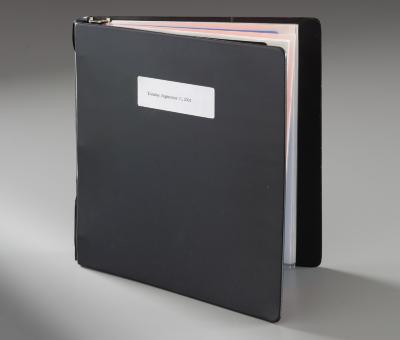
Binder
- Description
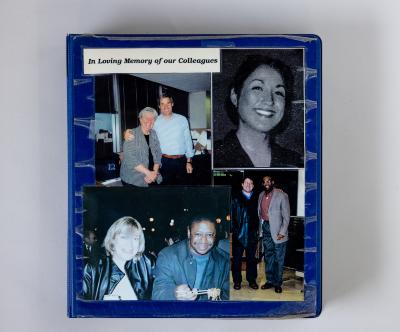
- Blue 3-ring binder filled with printed screenshots of various social media posts from elected officials related to various commemorative statements made in relation to 9/11 and vowing to "Never Forget." Some of the print-outs include images. The binder is organized in two sections, U.S. Senate and the House of Representatives. It is further alphabetized by state.
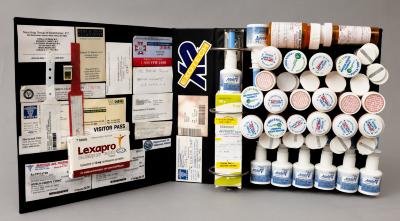
In the front cover sleeve of the binder is a print-out of the post by Marco Rubio dated September 11, 2018 with the statement: "Today is a day for remembrance and quiet reflection. We will never forget the heroes and victims of September 11, 2001," followed by a graphic of the New York city skyline with the Twin Towers. The inside cover of the binder includes a photo of the late Ray Pfeifer, an FDNY Hockey Team sticker, a copied newspaper photo of the FDNY Youth Team, and a Post-It note with "XoXo I Love You Dad" handwritten on it. At the top of the binder cover is handwritten: "'Book of Shame | By Rob Serra | FGF TL5." - Historical Notes
- Robert Serra was an FDNY probationary firefighter having just completed the FDNY Academy on September 10th. He deployed to Ground Zero on the afternoon of September 11, 2001. Serra, who had never previously responded to any fire or other emergency, worked at Ground Zero overnight and returned home exhausted the next morning. Serra was subsequently detailed to Ladder 136 in the Elmhurst neighborhood of Queens and continued to work during the rescue and recovery period at Ground Zero. Serra retired from the FDNY in December 2012 due to 9/11-related health problems, suffering from breathing problems (including diminished lung capacity by October 2001), sinus infections, and sinus polyps.
Serra became involved with John Feal's Feal Good Foundation to advocate for the James Zadroga 9/11 Health and Compensation Reauthorization Act (2015) and the Never Forget the Heroes: James Zadroga, Ray Pfeifer, and Luis Alvarez Permanent Authorization of the September 11th Victim Compensation Fund Act (2019). Serra went on organized trips to Washington, D.C. to meet with members of Congress who did not support the proposed legislation. During Serra’s multiple lobbying expeditions to Washington, D.C., with the FealGood Foundation delegation in 2018 and 2019, he assembled a blue plastic 3-ring notebook which he dubbed “the Book of Shame.” It functioned as a strategic tool for gathering evidence of the social media and other publicly released vows by elected officials to “Never Forget” the heroes and victims of 9/11, typically timed to reach their constituents on the September 11th anniversary. As delays ensued in gaining the vote count needed to extend and replenish the VCF Fund to aid 9/11 rescue and recovery personnel in light of their spiraling medical needs, the FealGood Foundation team decided to use these publicized pledges to remind disinclined politicians of their hypocrisy in withholding support of the proposed bill in light of the sentiments they were sharing on Twitter accounts and via official press releases.
Curator's Comment
The 9/11 attacks continue to affect the health and well-being of victims’ families and friends, survivors, rescue and recovery workers, cleaning crews, and those living and working in the vicinity of the three crash sites. Some injuries were immediately obvious, requiring hospitalization, surgeries, and lengthy recuperations. Other injuries were less apparent, including emotional scars and later illnesses.
Almost immediately, questions arose about the long-term impact of exposure to the dust clouds that formed when the towers collapsed on 9/11 and the dangers of working at the site during the recovery. Days after the attack, the U.S. Environmental Protection Agency declared the air in lower Manhattan safe. Subsequent tests showed that the omnipresent dust—made of pulverized building materials, industrial chemicals, and electronics mingled with jet fuel residue—was hazardous. Critics accused the government of a failure to protect citizens and inconsistent enforcement of respirator use at Ground Zero.
Survivors, residents, workers, and concerned citizens fought for legal remedies for injuries, treatment expenses, and loss of work. After years of debate, the U.S. Congress passed the James Zadroga 9/11 Health and Compensation Act in 2010. The landmark bill provides financial compensation to individuals who suffered physical injury or death as a result of the 9/11 attacks and established a program that monitors and treats those with 9/11-related health conditions. Congress reauthorized the Zadroga Act in 2015, extending the compensation fund for five additional years and the health program through 2090. In 2019, after another lobbying effort, the compensation fund was extended through 2092. More than 95,000 people living in all 50 states have enrolled in the World Trade Center Health Program.
Almost immediately, questions arose about the long-term impact of exposure to the dust clouds that formed when the towers collapsed on 9/11 and the dangers of working at the site during the recovery. Days after the attack, the U.S. Environmental Protection Agency declared the air in lower Manhattan safe. Subsequent tests showed that the omnipresent dust—made of pulverized building materials, industrial chemicals, and electronics mingled with jet fuel residue—was hazardous. Critics accused the government of a failure to protect citizens and inconsistent enforcement of respirator use at Ground Zero.
Survivors, residents, workers, and concerned citizens fought for legal remedies for injuries, treatment expenses, and loss of work. After years of debate, the U.S. Congress passed the James Zadroga 9/11 Health and Compensation Act in 2010. The landmark bill provides financial compensation to individuals who suffered physical injury or death as a result of the 9/11 attacks and established a program that monitors and treats those with 9/11-related health conditions. Congress reauthorized the Zadroga Act in 2015, extending the compensation fund for five additional years and the health program through 2090. In 2019, after another lobbying effort, the compensation fund was extended through 2092. More than 95,000 people living in all 50 states have enrolled in the World Trade Center Health Program.
- Accession Number: C.2020.74.4
- Dimensions: 11 in X 11.5 in X 1.5 in
- Dimensions (Metric): 27.94 cm X 29.21 cm X 3.81 cm
- Source: Robert Serra
- Credit Line: Gift of Firefighter Rob Serra
Health EffectsNever Forget the Heroes: James Zadroga, Ray Pfeifer, and Luis Alvarez Permanent Authorization of the September 11th Victim Compensation Fund Act. Rescue and Recovery
All materials made publicly available by the 9/11 Memorial & Museum on this site are intended for research and educational use only. Users may need to obtain other permissions for their intended use(s) and are responsible for determining copyright status and securing these permissions.
To inquire about copyrights and reproductions, contact: xxx@911memorial.org