Painting
Kakrak
- Description
-
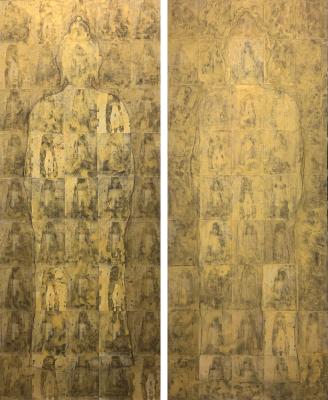
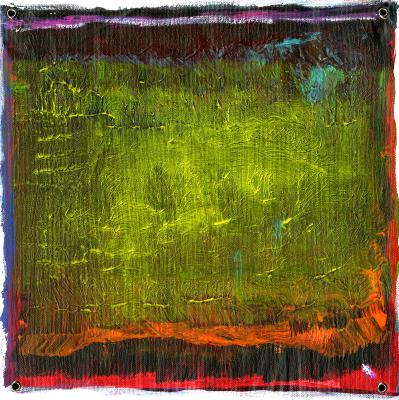
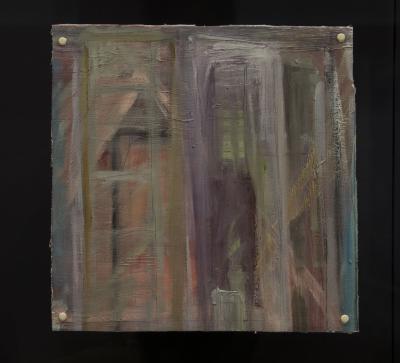
Diptych painting created by Andra Samelson titled Kakrak and Shahmama. The diptych is created with acrylic and ink on papers mounted on canvas. The paintings each depict a tall standing Buddha rendered over repeated images of the world’s two tallest standing statues of Buddha destroyed on March 11, 2001, in Bamiyan, Afghanistan.
When the diptych is displayed, the two panels represent the Twin Towers. - Historical Notes
- A multimedia artist based in New York, Andra Samelson was not in the city on 9/11 but was deeply impacted by the event. Further inspired by her personal spiritualism as a student of Vajrayana Buddhism for over 40 years, Samelson explained her concept for the diptych Kakrak and Shahmama as a response to the linked 2001 tragedies of the destruction of the Bamiyan Buddhas in Afghanistan and of the World Trade Center Twin Towers. The titles refer to the respective designations of the niches occupied by each ancient Buddhist statues and their vertical pairing recalls the Twin Towers no longer upright in lower Manhattan’s skyline.
The works presented to the 9/11 Memorial & Museum have not been displayed outside of Samelson’s New York studio. For them, she repeated her use of an Epson ink jet printer to produce images of the maimed Bamiyan Buddhas on paper affixed to the underlying canvas via a guiding grid. On top of this gridded ground, she used golden fluid matte and Liquitex iridescent bronze and gold acrylic paint to render the standing Buddha figures.
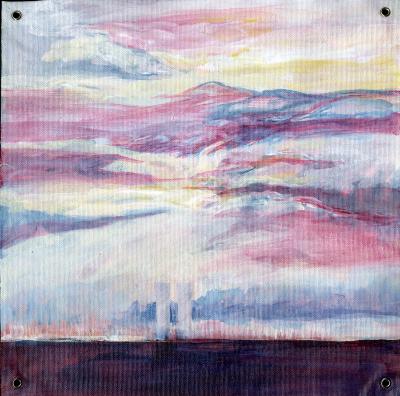
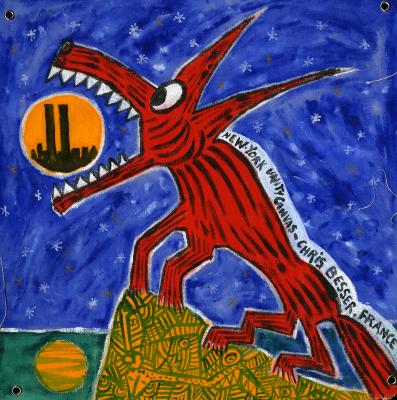
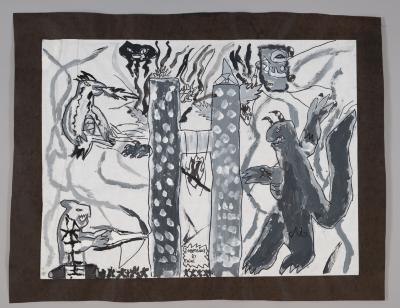
Although separated by six months and a half a world’s distance, the leveling of the two historic Bamiyan Valley figures and the Twin Towers have figured thematically in the response to 9/11 by other visual artists sensing their international parallelisms of political sabotage.
More than 1,500 years ago, the Bamiyan Valley of Afghanistan’s central highlands was a vibrant Buddhist monastic center—a destination for pilgrims and stopping point on the ancient Silk Road, where traders and travelers exchanged goods and ideas from both East and West. People came to Bamiyan to worship, learn, and see the two colossal Buddhas carved into the valley’s sandstone cliffs. Standing about 175 feet high, the Buddha on the western end of the cliffside was taller than the Statue of Liberty from base to torch, and the eastern Buddha measured about 120 feet tall. Dating to around the fifth century CE, the Buddhas reflected Indian, Central Asian, and Greek and Roman influences. The statues were covered in stucco and painted dazzling colors. In the cliffsides surrounding the massive Buddhas, hundreds of caves served as chapels and places of contemplation for monks and pilgrims, with colorful murals covering the walls and ceilings.
The Bamiyan Buddhas stood for more than a millennium, surviving Mongol ruler Genghis Khan’s destruction of the city in 1221 CE and later defacement in the 17th, 18th, and 19th centuries. In 2001, however, they fell. In late February of that year, Taliban leader Mullah Mohammad Omar—possibly encouraged by al-Qaeda—ordered the destruction of Afghanistan’s famous Buddha statues, declaring them “insulting to Islam.” Heads of state, religious leaders, and cultural heritage advocates around the world pleaded with the Taliban to save the Buddhas; New York City’s Metropolitan Museum of Art even offered to buy the statues if that would ensure their preservation.
Taliban leaders refused.
Beginning on March 2 and continuing for weeks, Taliban troops launched an all-out assault on the Buddhas, firing at them with guns, tank shells, rocket launchers, and anti-aircraft weapons. When this only succeeded in damaging the statues, they ordered men to drill holes into the Buddhas and plant explosives that would destroy the ancient figures once and for all. By the end of March 2001, the Bamiyan Buddhas had been reduced to piles of rubble; the only sign of them were the empty niches in the cliffsides where they had stood for 1,500 years.
- Accession Number: C.2021.52.1
- Dimensions: 112 in X 90 in
- Dimensions (Metric): 284.48 cm X 228.6 cm
- Source: Lawrence Shainberg
- Credit Line: Gift of Lawrence Shainberg
All materials made publicly available by the 9/11 Memorial & Museum on this site are intended for research and educational use only. Users may need to obtain other permissions for their intended use(s) and are responsible for determining copyright status and securing these permissions.
To inquire about copyrights and reproductions, contact: xxx@911memorial.org