Design Plan
The Towers as Light
- Description
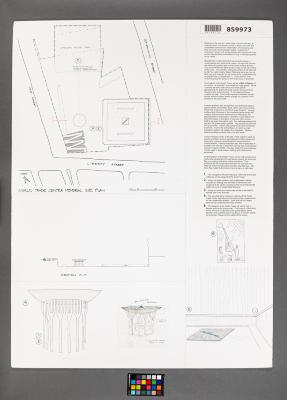
- Foam core submission board designed for the World Trade Center Site Memorial Competition in 2003 titled “The Towers as Light.” The Tribute in Light is two columns of blue light meant to represent the Twin Towers that extended infinitely upwards and were first displayed near Ground Zero six months after 9/11. This design plan proposes incorporating the Tribute in Light as a permanent installation.
The descriptive text on the board reads:
Projecting from New York Harbor, we propose that once again two beacons of light complete the New York City skyline.
Rarely has a memorial, public artwork, building or spectacle been as universally embraced as the temporary memorial, Tribute in Light, which appeared on the New York skyline March 11th of 2002. Its serene, quiet, ghostly image seemingly able to express as many meanings as viewers beheld it. To some it symbolized the souls of the dead rising, to others it was represented the triumph of light over darkness. To many it was the perfect memorial. At the time a public outcry swelled demanding it be extended beyond its 32 day scheduled run.
New York Harbor is the ideal location for recreating this memorial. Here the infinite beans projecting from the water’s surface to the heavens, with all their grandeur and symbolism, would be mirrored. Now infinite beams of light would project similarly into the world of reflection. To reflect is to remember, and the light sources themselves, located at the water’s surface, where our world meets the world of reflection, become a symbol on September 11th 2001, when the World Trade Center Towers, and the people in them, left our world for the world of memory. Although grounded in the riverbed to avoid movement from the tides and wakes, the lights would appear to float, suspended between these two worlds- a point along an endless continuum.
In the harbor the Tribute in Light would also become a part of a larger composition comprised of the lights, the New York City skyline and the Statue of Liberty. This collection of powerful images would give this civic monument a national scale and constitute a declaration of universal ideals.
In addition, but certainly not necessarily, the installation of the lights might contain a fountain giving it presence by day and enhancing its reflection by night. This fountain might transform the two squares of the light arrangements into cubes of water, as high as they are wide, the silvery jets of water recalling the color of the buildings now gone.
The light memorial could illuminate nightly, but would be best reserved to mark special occasions, to dress the city in celebration or remembrance. The occasions might include the week surrounding Sep. 11, Independence Day, Memorial Day, and many other appropriate occasions.
Our proposal is not in lieu of, but rather in addition to a memorial at the site offered in this memorial competition. A memorial on the site where the World Trade Center towers once stood, a site where so many lives were lost and so much heroism demonstrated, must certainly be a fundamental expression of our grief, a tribute to those who lost their lives, and a pledge to never forget. But it need not be, and we believe should not be, the only expression.
The destruction of the World Trade Center and the tremendous losses suffered that day must be memorialized in many different ways, and at many different sites. In fact, this process has already begun. Memorials have been erected at local firehouses and public spaces throughout our city, our nation, and the world. Although some may be quite small, all have great feeling and meaning. These plaques, markers, fountains and more should be understood collectively and whatever is built at the site, and any other tributes to come, simply add to this ongoing process of memorialization.
These lights are symbolic, and not literally a reconstruction of the towers, therefore they need not be located precisely on the tower footprints. In fact, the original installation of Tribute in Light was only near—not on the actual footprints. New York Harbor offers several possible sites where the installation would not interfere with navigation nor disrupt the harbor in any way. There are many practical advantages to a harbor site as well, including security and not disturbing neighboring residential communities. Moreover, though the lights and possible fountain could certainly be driven by diesel generators, the space of the harbor might also allow for the harnessing power from the sun or wind. Solar panels or windmills might even become another beautiful way of marking the location of the lights and giving them presence by day. Importantly, a harbor site would also free the tower footprints for the most beautiful and appropriate memorial without need to integrate the infrastructure of lights, which would serve no purpose during daylight hours.
This proposal would not compete with a memorial at the site of the building footprints, rather, the two gestures would compliment one another. But they need not be contingent on each other either. The two designs could be entirely independent. As a result, recreation of Tribute in Light need not wait for the creation of a memorial at the footprints. This memorial could be planned and installed even before final decisions are made regarding the rebuilding of the World Trade Center Site. - Historical Notes
- John Bennett graduated with a master’s degree in architecture from Columbia University in 1993. His design partner Gustavo Bonevardi graduated with a master’s in architecture from Princeton University in 1986. The two co-founded PROUN Space Studio, an architectural design firm based in New York City’s West Village.
On 9/11, Bonevardi was living in his family home at Greenwich and 12th Streets; there, he witnessed the collapse of the Twin Towers, which had stood as a backdrop to his childhood. Bennett was similarly preparing for the day’s work at the firm’s offices. The next day, both men began envisioning the concept for a commemorative light installation honoring those lost in the attacks. The installation would illustrate the eternal nature of the events of 9/11 and the irreplaceable memories of those who lost their lives, exemplified by the columns of light stretching into the sky ad infinitum. In March 2002, Bennett and Bonevardi worked with several other artists, architects, and lighting designers to present Tribute in Light publicly for the first time. Funding was provided by the public arts organization Creative Time and the Municipal Arts Society. Bonevardi and Bennett intended for the Tribute to not only fill a void in New York City’s skyline, but also to fill a void in the city’s identity while assisting the collective healing process. The pair saw Tribute in Light as an excellent complement to other on-the-ground permanent memorials due to its proposed ritual of annual lighting and ephemeral qualities.
- Accession Number: C.2021.58.13
- Dimensions: 40 in X 30 in X 1/2 in
- Dimensions (Metric): 101.6 cm X 76.2 cm X 2.54 cm
- Source: Lower Manhattan Development Corporation
- Credit Line: Collection 9/11 Memorial Museum
All materials made publicly available by the 9/11 Memorial & Museum on this site are intended for research and educational use only. Users may need to obtain other permissions for their intended use(s) and are responsible for determining copyright status and securing these permissions.
To inquire about copyrights and reproductions, contact: xxx@911memorial.org