Design Plan
- Description
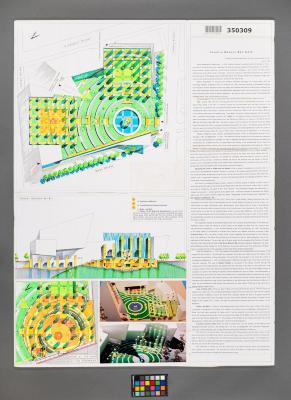
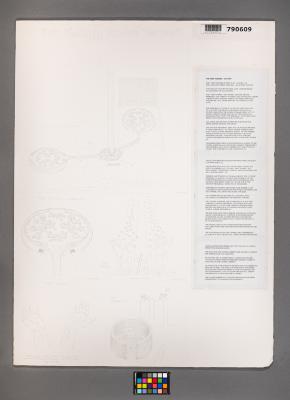
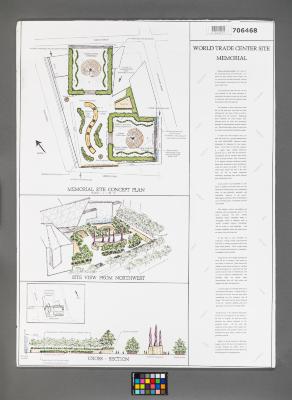
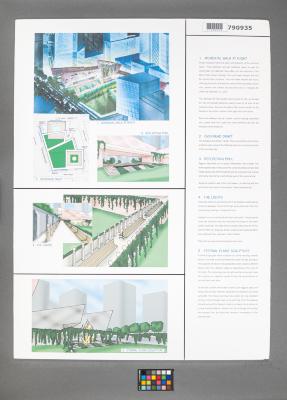
- Untitled foam core submission board designed for the World Trade Center Site Memorial Competition in 2003. This design plan features an artistic rendering of memorial spaces outlining the Twin Tower footprints as well as Koenig’s the Sphere sculpture raised atop a granite base.
The descriptive text on the board reads:
The projected memorial at Ground Zero responds with monumental clarity to the irreplaceable loss of human life and the WTC’s Twin Towers. The creation of the sunken plain of the memorial, freed from debris, contrasts starkly and deliberately with the bustle of Manhattan street life. Focusing on the rescued fragment of the fountain sculpture and a strict reduction in the materials used, the wound in the fabric of NYC makes a lasting impression.
Wide, structured concrete ramps open up the area to the South for visitors. The wall that retains the area towards the Hudson is not affected.
The center of the memorial site is v [sic] Fritz Koenig’s “Kugelkaryatide NY,” erected at the WTC Plaza in 1971. Damaged but not destroyed, the sculpture survived the September 11 catastrophe protected under the rubble. As a symbol of destruction and triumph over destruction, the sculpture shall be moved from its temporary home in Battery Park back to its original location. The sculpture will be stabilized and will be able to revolve mechanically. It will be erected on a disk-shaped base of polished black granite, on whose sides all the names of the victims of the WTC attacks are chiseled. The sculpture, as it did in its original location, links the square bases of the Towers in spatial unity. As one nears the Sphere, the black base of it causes the surroundings to fade away; one’s focus is concentrated on the infinite list of names. A space between the base wall and the floor has been allotted, allowing mourners to place flowers and candles there.
Bordered by pit walls, the expanse of the square is uniformly paved with grey granite; and the raised footprints of the Twin Towers, both of whose monumental gravestones are identical, impinge on the visitors’ field of movement. The human remains of the unidentified victims are symbolically manifested in these stone cenotaphs which cannot be walked upon. Only a narrow path provides access to the interior, which is screened off from the surroundings by the immense expanse, and which thus can be used as a place of retreat for prayer, reflection, and meditation. - Historical Notes
- Fritz Koenig was a German sculptor whose works defined and shape many public spaces in Germany and across the world. Born in Würzburgand, Germany, Koenig studied under Anton Hiller at the Akademie der Bildenden Künste (Academy of Fine Arts) in Munich from 1946 to 1952. Later, he was granted a scholarship to Villa Massimo, the German Academy in Rome. In 1964, he was appointed as the chair for sculptural design in the Faculty of Architecture at the Technical University of Munich. Commemorating difficult history has been a central interest of Koenig's, which is reflected in the various memorials he designed, including one honoring the victims of the Mauthausen concentration camp and another dedicated to the Israeli athletes killed during the 1972 Munich Olympics.
In New York City (where the first exhibition of his work in the United States took place in 1961, at the Staempfli Gallery), Koenig is best known as the sculptor of Grosse Kugelkaryatide N.Y., or the Sphere: a massive cast bronze sculpture installed in 1971 at the center of Austin J. Tobin Plaza at the World Trade Center. The sculpture was damaged—but not destroyed—in the 9/11 attacks and was later relocated to Battery Park. The visibly damaged piece was ultimately moved to Liberty Park, adjacent to the 9/11 Memorial site, in September 2017. Speaking with museum staff about his own experience of 9/11, Koenig recalled that he was downstairs in his studio in Ganslberg, Germany, when his wife ran in with news of the catastrophe across the Atlantic. The sculptor traveled to New York in the weeks following 9/11 with the hope of locating and salvaging his work. Somewhat miraculously, the sculpture survived only moderately damaged following the collapse of the Twin Towers. A decision was made to preserve and utilize the piece as an interim memorial, and Koenig returned from Germany to attend the the dedication of the Sphere in Battery Park on the six-month anniversary of the attacks.
The competition board shows how Koenig’s proposal for the memorial centers the Sphere—in its scarred, contorted, but stabilized form—between two sunken spaces to project the Twin Towers as “monumental gravestones.” The names of victims were to be inscribed on the black granite base on which Koenig’s sculpture would be installed. His plan for the memorial site would stand in deliberate contrast to the “bustle of Manhattan street life” to remind mourners and visitors of the calamitous events that took place.
- Accession Number: C.2021.58.12
- Dimensions: 40 in X 28 1/4" X 1 1/2"
- Dimensions (Metric): 101.6 cm X 71.12 cm X 2.54 cm
- Source: Lower Manhattan Development Corporation
- Credit Line: Collection 9/11 Memorial Museum
All materials made publicly available by the 9/11 Memorial & Museum on this site are intended for research and educational use only. Users may need to obtain other permissions for their intended use(s) and are responsible for determining copyright status and securing these permissions.
To inquire about copyrights and reproductions, contact: xxx@911memorial.org