Respirator
- Description
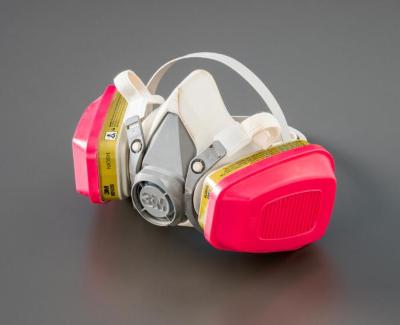
- 3M brand half-mask respirator with black silicone face-piece cushion and black adjustable straps. The plastic filter cartridges are North brand purple filters with "D'Aleo R/S" handwritten in black marker on both cartridges.
- Historical Notes
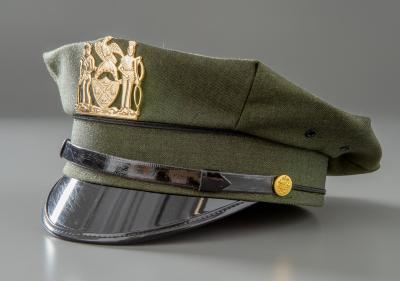
- In addition to collecting, recycling, and disposing of the city’s waste, the New York City Department of Sanitation (DSNY) also clears streets of debris, snow, and ice. On September 11, 2001, DSNY sent equipment and more than 1,000 workers to Ground Zero to aid the rescue efforts. Throughout the nine-month recovery period, DSNY personnel removed debris, provided garbage and recycling services, and washed streets to keep toxic dust from spreading around lower Manhattan.
By September 12, 2001, DSNY had reopened the recently closed Fresh Kills Landfill on Staten Island. There, they hosted NYPD‑ and FBI‑led recovery operations, which included searching for criminal evidence, human remains, and personal effects. DSNY workers unloaded and separated materials from barges and trucks for detailed screening.
Curator's Comment
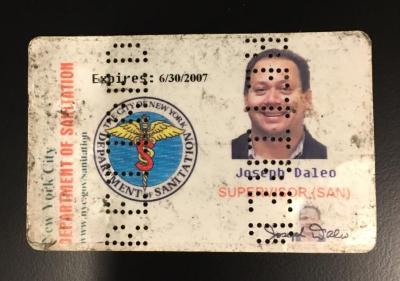
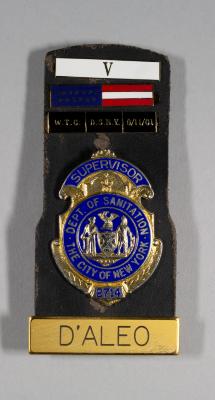
Native New Yorker Joseph D’Aleo grew up in the Gravesend section of Brooklyn. He was hired by the New York City Department of Sanitation (DSNY) in the 1980s, receiving an initial assignment at a garage in Manhattan. After a short time in that location, he moved to various other garages in south Brooklyn before landing a position in the Bureau Operations Office (BOO) in 1998.
Two weeks prior to September 11, 2001, D’Aleo was transferred from Brooklyn back to Manhattan as supervisor of a DSNY garage. He was in charge of the safe disposal of appliances containing Freon or chlorofluorocarbon gas (CFC), coordination of pick-ups by E-Z pack trucks, and swapping out dumpsters. On Tuesday, September 11, D’Aleo and his DSNY partner, Steve Canon, were at an appointment near the World Trade Center when they witnessed hijacked Flight 11 hit the North Tower.
Realizing that a commercial airliner had just crashed into the nearby tower, D’Aleo immediately recognized the act as a deliberate one. Using his handheld radio, he ordered the immediate evacuation of all DSNY personnel from lower Manhattan. He followed up with a call to 911 to relay what he’d just witnessed.
While D’Aleo’s initial instinct was to run toward the buildings and assist emergency service personnel leading the evacuation, his partner feared that the towers were vulnerable to collapse. He urged D’Aleo to vacate the scene, and the pair left just before the South Tower collapsed. They were sheltered at a nearby DSNY garage facility when the North Tower fell a short time later. D’Aleo returned to the World Trade Center site as soon as the smoke cleared in order to distribute dust masks to first responders.
Over the next 12 months, D’Aleo went to Ground Zero daily in his capacity as a DSNY supervisor. While there, he oversaw refuse hauling, dumpster removal, and recycling procedures at the site. He also ensured that flagged truckloads of material were removed to Fresh Kills Landfill for further sifting and cleared others for disposal at a Manhattan facility.
In January 2002, D’Aleo started to develop a persistent cough. Initially thought to be asthma-related, the cough was later diagnosed as a symptom of sarcoidosis, an incurable inflammatory disease. Over the years, D’Aleo’s health issues continued to intensify as he subsequently suffered from fibromyalgia, GERD, sinusitis, sleep apnea, neurosarcoidosis, and multiple cranial nerve palsies. As of September 2018, D’Aleo was taking over 20 prescribed pills a day to manage the symptoms of his various health conditions.
D’Aleo retired from the DSNY in 2004.
Two weeks prior to September 11, 2001, D’Aleo was transferred from Brooklyn back to Manhattan as supervisor of a DSNY garage. He was in charge of the safe disposal of appliances containing Freon or chlorofluorocarbon gas (CFC), coordination of pick-ups by E-Z pack trucks, and swapping out dumpsters. On Tuesday, September 11, D’Aleo and his DSNY partner, Steve Canon, were at an appointment near the World Trade Center when they witnessed hijacked Flight 11 hit the North Tower.
Realizing that a commercial airliner had just crashed into the nearby tower, D’Aleo immediately recognized the act as a deliberate one. Using his handheld radio, he ordered the immediate evacuation of all DSNY personnel from lower Manhattan. He followed up with a call to 911 to relay what he’d just witnessed.
While D’Aleo’s initial instinct was to run toward the buildings and assist emergency service personnel leading the evacuation, his partner feared that the towers were vulnerable to collapse. He urged D’Aleo to vacate the scene, and the pair left just before the South Tower collapsed. They were sheltered at a nearby DSNY garage facility when the North Tower fell a short time later. D’Aleo returned to the World Trade Center site as soon as the smoke cleared in order to distribute dust masks to first responders.
Over the next 12 months, D’Aleo went to Ground Zero daily in his capacity as a DSNY supervisor. While there, he oversaw refuse hauling, dumpster removal, and recycling procedures at the site. He also ensured that flagged truckloads of material were removed to Fresh Kills Landfill for further sifting and cleared others for disposal at a Manhattan facility.
In January 2002, D’Aleo started to develop a persistent cough. Initially thought to be asthma-related, the cough was later diagnosed as a symptom of sarcoidosis, an incurable inflammatory disease. Over the years, D’Aleo’s health issues continued to intensify as he subsequently suffered from fibromyalgia, GERD, sinusitis, sleep apnea, neurosarcoidosis, and multiple cranial nerve palsies. As of September 2018, D’Aleo was taking over 20 prescribed pills a day to manage the symptoms of his various health conditions.
D’Aleo retired from the DSNY in 2004.
- Accession Number: C.2019.24.5
- Dimensions: 6 in X 9.5 in
- Dimensions (Metric): 15.24 cm X 24.13 cm
- Source: Joseph D'Aleo
- Credit Line: Gift of Joseph D'Aleo
Health EffectsNew York City Department of Sanitation (DSNY)Rescue and RecoveryWorn or Used After 9/11
All materials made publicly available by the 9/11 Memorial & Museum on this site are intended for research and educational use only. Users may need to obtain other permissions for their intended use(s) and are responsible for determining copyright status and securing these permissions.
To inquire about copyrights and reproductions, contact: xxx@911memorial.org