Quilt
America's 9/11 Victims’ Memorial Quilt
- Description
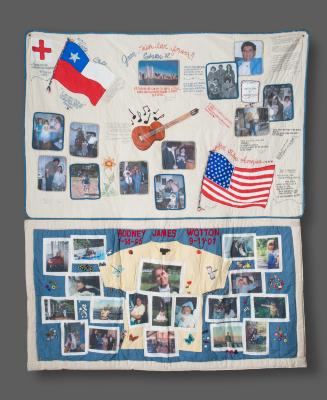
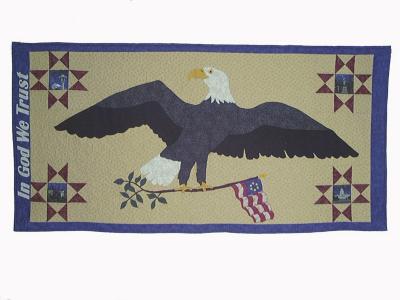
- Handmade textile quilt composed of three 20-foot sections, each dedicated to one of the three 9/11 attack sites. Each site is pictured on the quilt. The names and photographs of victims form the primary design. Victims without photos are represented by candle icons. The faces are arranged in groups by company, flight, and responder agency. The quilt also features images of emergency vehicles, patriotic symbols, and two poems, "Nation of Survivors," written by Jack Foshee Jr., and Marigrace Iodice’s "The Day I Saw My Lady Cry."
- Historical Notes
- The Victims Quilt was created as part of the America’s 9/11 Memorial Quilts Project and honors all who were killed during the 9/11 terrorist attacks and those who came to their rescue. Maintaining the tradition of quilting as a communal activity, more than 500 individuals nationwide worked together to make a quilt that would provide symbolic comfort to those in mourning. Inspiration for the Memorial Quilts Project came from a grassroots effort led by designer Jeannie Ammerman from Tennessee, with assistance provided by Bonnie Clark from Illinois, Connie Daniel from Wisconsin, and numerous volunteers.
The Victims Quilt was dedicated to 9/11 victims’ families on September 9, 2006, in a ceremony held on the occasion of the fifth anniversary of 9/11, and was accepted on their behalf by Bill Doyle, father of Joseph Michael Doyle. In turn, Bill Doyle presented the quilt to the 9/11 Memorial Museum in the name of all 9/11 families.
Curator's Comment
The terrorist attacks of September 11, 2001, ignited a global passion to provide aid and comfort. For those unable to participate in actual rescue and recovery efforts at the various disaster sites, quilting emerged as one practical and creative way to demonstrate compassion and support for 9/11 family members, responders, survivors, and others who were profoundly affected by the attacks.
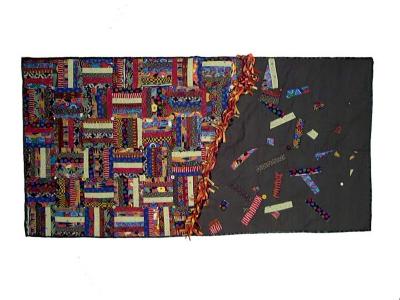
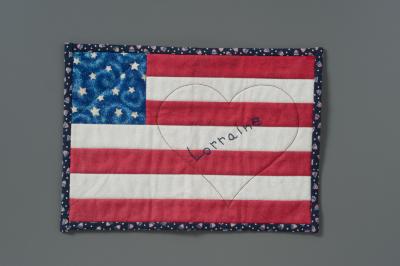
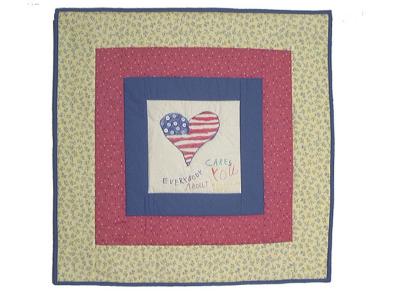
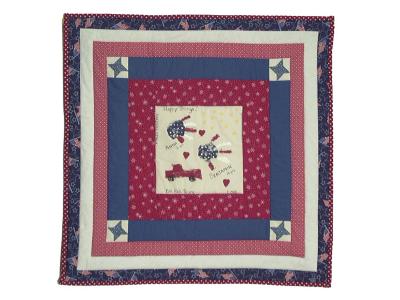
Traditionally the outcome of either communal or solitary cutting, piecing, and sewing efforts, quilts are both functional and tactile expressions of their makers’ emotions, ideas, and materials at hand that could be recruited into meaningful service. Those drawn to making quilts in response to 9/11 frequently used patriotic motifs, religious symbols, and images that quickly became emblematic of the attacks, such as the Twin Towers, the 5-sided Pentagon, airplanes, and firefighting paraphernalia. Some quilts served as memorial gestures in honor of specific individuals or groups of coworkers who had been killed while also performing therapeutic and healing functions for those making them. Communication of the magnitude of human loss suffered on 9/11 and the event’s disproportionate impact on particular companies, agencies, towns, and colleges are other themes that emerged among quilters.
Traditionally the outcome of either communal or solitary cutting, piecing, and sewing efforts, quilts are both functional and tactile expressions of their makers’ emotions, ideas, and materials at hand that could be recruited into meaningful service. Those drawn to making quilts in response to 9/11 frequently used patriotic motifs, religious symbols, and images that quickly became emblematic of the attacks, such as the Twin Towers, the 5-sided Pentagon, airplanes, and firefighting paraphernalia. Some quilts served as memorial gestures in honor of specific individuals or groups of coworkers who had been killed while also performing therapeutic and healing functions for those making them. Communication of the magnitude of human loss suffered on 9/11 and the event’s disproportionate impact on particular companies, agencies, towns, and colleges are other themes that emerged among quilters.
- Accession Number: C.2006.2.1
- Dimensions: 10 ft X 60 ft
- Dimensions (Metric): 25.4 cm X 152.4 cm
- Source: William Doyle
- Credit Line: Gift of Bill Doyle on behalf of the intended 9/11 family recipients of the Victims' Quilt
All materials made publicly available by the 9/11 Memorial & Museum on this site are intended for research and educational use only. Users may need to obtain other permissions for their intended use(s) and are responsible for determining copyright status and securing these permissions.
To inquire about copyrights and reproductions, contact: xxx@911memorial.org