Flag
- Description
- Large Spanish flag with handwritten message on the front that reads: "UNITED WE STAND | IN LOVING MEMORY OF SEPTEMBER 11 HEROES | EN MEMORIA DE LOS HÉROES DEL 11 DE SEPTIEMBRE." There are a number of handwritten signatures covering the flag.
- Historical Notes
- The flag, featuring messages of sympathy and solidarity written in English and Spanish, is signed by individuals whose relationship to the attacks or victims is unclear. Official counts of 9/11 victims list only one Spaniard, Edelmiro Abad, who was born in Burgos, Spain, and lived in Brooklyn while working at Fiduciary Trust.
Curator's Comment
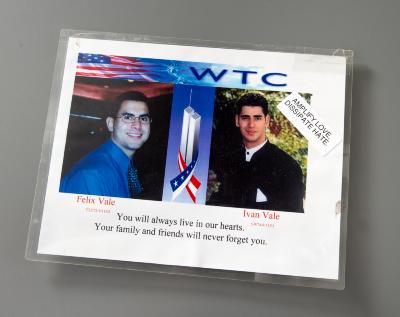
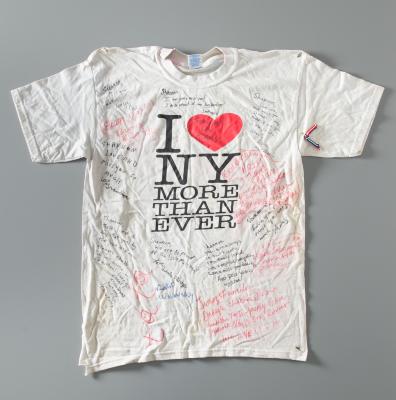
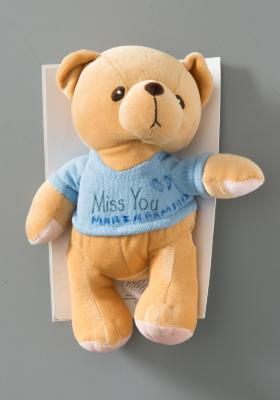
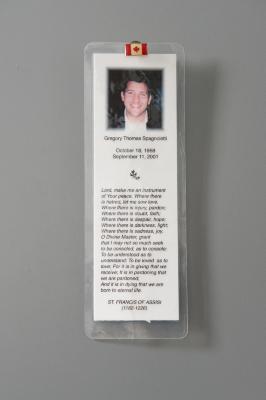
This flag is one of hundreds of items collected by Keith Piaseczny as a founder of ArtAID. After earning a degree in sociology and photography at Manhattanville College, Piaseczny lived in Europe, Nicaragua, and Detroit before moving back to New York City in the early 1990s to pursue his artistic interests. In 1995, he conceived of ArtAID as an online venue for artists to leverage their artistic capabilities in socially responsible ways. It took the events of September 11, 2001 to catalyze the endeavor.
On 9/11, Piaseczny witnessed the attacks on the World Trade Center from his apartment building’s rooftop on 6th Avenue. Determined to become involved in the relief efforts, he was embraced by the volunteer community at Ground Zero and at the relief center at St. Paul’s Chapel. In December 2001, Piaseczny was asked by the NYPD to create a more inspiring, reflective atmosphere along the family viewing platform entryway. ArtAID responded by designing a memorial banner listing the names of all who had died in the attack on the World Trade Center. As soon as the banner was installed, visitors began using it as a canvas upon which to write messages of sympathy and support for the victims, their families, recovery workers, and New Yorkers at large.
Piaseczny and other volunteers took a deep personal interest in caring for the platform and tributes left there. Piaseczny improvised ways to accommodate the proliferating tributes, laminating paper offerings to prevent damage and removing weather-worn tributes. He became the unofficial steward of the platforms, staying responsive to the needs of the public and those most affected by loss. In the summer, as news spread that both platforms would be removed, Piaseczny and his circle of volunteers respectfully removed the banners and preserved many of the objects that had been placed there by those paying their respects.
Piaseczny’s efforts can be contextualized in a greater landscape of radical volunteerism and grassroots humanitarian work that characterized the unprecedented public response to 9/11. Anticipating that a permanent memorial or museum might someday emerge to narrate the history and consequence of the attacks, Piaseczny preserved as much of the viewing platform materials as possible, stowing them at his own expense for eight years before transferring several bins of tribute items and ArtAID posters and banners to the Museum in 2009.
On 9/11, Piaseczny witnessed the attacks on the World Trade Center from his apartment building’s rooftop on 6th Avenue. Determined to become involved in the relief efforts, he was embraced by the volunteer community at Ground Zero and at the relief center at St. Paul’s Chapel. In December 2001, Piaseczny was asked by the NYPD to create a more inspiring, reflective atmosphere along the family viewing platform entryway. ArtAID responded by designing a memorial banner listing the names of all who had died in the attack on the World Trade Center. As soon as the banner was installed, visitors began using it as a canvas upon which to write messages of sympathy and support for the victims, their families, recovery workers, and New Yorkers at large.
Piaseczny and other volunteers took a deep personal interest in caring for the platform and tributes left there. Piaseczny improvised ways to accommodate the proliferating tributes, laminating paper offerings to prevent damage and removing weather-worn tributes. He became the unofficial steward of the platforms, staying responsive to the needs of the public and those most affected by loss. In the summer, as news spread that both platforms would be removed, Piaseczny and his circle of volunteers respectfully removed the banners and preserved many of the objects that had been placed there by those paying their respects.
Piaseczny’s efforts can be contextualized in a greater landscape of radical volunteerism and grassroots humanitarian work that characterized the unprecedented public response to 9/11. Anticipating that a permanent memorial or museum might someday emerge to narrate the history and consequence of the attacks, Piaseczny preserved as much of the viewing platform materials as possible, stowing them at his own expense for eight years before transferring several bins of tribute items and ArtAID posters and banners to the Museum in 2009.
- Accession Number: C.2015.288.872
- Dimensions: 34.25 in X 53.375 in
- Dimensions (Metric): 86.995 cm X 135.5725 cm
- Source: Keith J. De Cesare
- Credit Line: Gift of Keith Piaseczny
All materials made publicly available by the 9/11 Memorial & Museum on this site are intended for research and educational use only. Users may need to obtain other permissions for their intended use(s) and are responsible for determining copyright status and securing these permissions.
To inquire about copyrights and reproductions, contact: xxx@911memorial.org