Photograph, Print
Barry Crumbley, Red Cross Volunteer
- Description
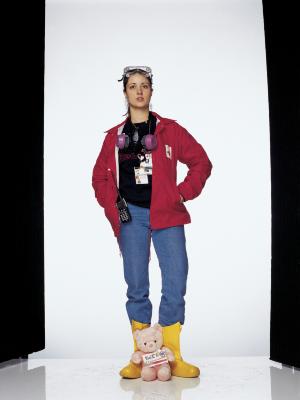
- Life-sized Polaroid photograph taken by Joe McNally depicting Red Cross volunteer Barry Crumbley. Crumbley is wearing his red Disaster Relief jacket and his white Red Cross hard hat. The hat has a small stuffed teddy bear attached to it. Crumbley has a respirator hanging around his neck, and he holds goggles in his hand.
- Historical Notes
- In 2001, Barry Crumbley—a resident of Mount Vernon, New York—was serving as a government liaison to the American Red Cross of Greater New York. He coordinated the agency’s response protocols prior to, during, and following any large-scale disaster. Crumbley had graduated from the University of Wisconsin in Madison after studying both mortuary science and agricultural science. He later worked for New York City’s Office of the Chief Medical Examiner and in the pathology departments of two metro-area hospitals. Crumbley confronts McNally’s giant Polaroid lens wearing his Red Cross Disaster Relief jacket over a white branded Red Cross turtleneck, with a respirator around his neck and a pair of safety goggles clutched in his right hand. Crumbley also brought along a plush toy which decorates his white hard hat: a bear wearing a Red Cross cap and vest.
Crumbley’s connection to the dramatic attacks which leveled the World Trade Center was deeply personal. At 8:46a.m. that Tuesday morning, he was at home. His wife, Renee, employed by the Port Authority of NY&NJ, had left earlier for her job on the 64th floor of the North Tower. When she phoned him from her office to report a powerful explosion, he urged her to evacuate immediately. He then rushed to Red Cross headquarters in Midtown Manhattan and boarded one of the agency’s emergency response vehicles heading to lower Manhattan, anxious to locate Renee. He was at a safe distance from the Towers when he watched them collapse, the status of his wife still unknown. Crumbley recalled: “When I got to the scene, I witnessed people falling and one of the buildings fall. I didn’t know if Renee was out. I kept saying to myself, ‘this for real. This for real.’ I didn’t hear from her until six. It was one of the worst days of our lives.”
Curator's Comment
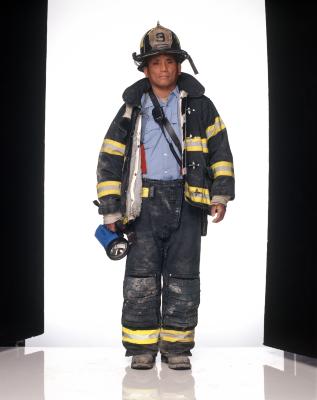
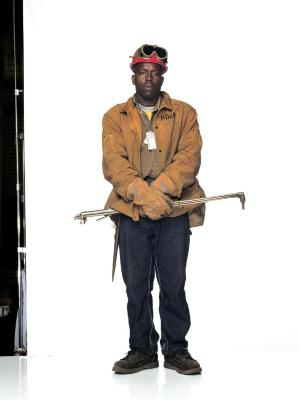
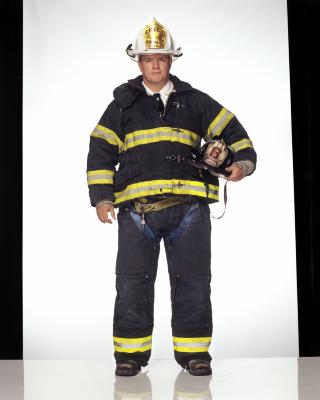
In the weeks after September 11, LIFE Magazine photographer Joe McNally (b. 1952) invited rescuers, recovery workers, survivors, and bereaved family members to a studio in Manhattan’s Bowery district, not far from Ground Zero. Here, the participants were memorialized by a unique Polaroid camera—dubbed the Moby C—equipped with a lens from a U-2 spy plane. This room-sized instrument could capture an exposure of singular clarity on an eight-foot tall piece of film in the blackened studio. Each 90-second session required meticulous staging and absolute stillness. Whereas most photographers were concentrating on documenting the devastation of the attacks downtown, McNally was interested in recording the heroism and sorrow etched into the human faces at the center of this national tragedy. Those who faced the camera were mostly everyday people who sought no special recognition. “They came only with the intention of participating in a project, telling their story, and sharing in the telling of others,” McNally reflected.
The 9/11 Memorial Museum has enjoyed a long relationship with McNally's images. In 2006, McNally donated his portrait of FDNY Ladder 20 firefighter Adrienne Walsh to support the Museum’s nascent permanent collection. When the outdoor Memorial opened to the public in 2011, a selection from the series was borrowed from the photographer and rotated onto view in the temporary Visitor Center at 90 West Street. Annual acquisitions from the Faces of Ground Zero archive have continued, often as gifts arranged by McNally. In 2017, the Museum assumed custody of the remaining Polaroids in an agreement that will result in the collection’s completed donation by 2027.
The image in this record is the product of a color transparency from a Mamiya RZ 6x7 Pro II 120 format camera that McNally positioned to record a shot simultaneous with the Polaroid Moby C’s flash of light. The unique, original Polaroid exhibits a more subtle and creamier tonality.
The 9/11 Memorial Museum has enjoyed a long relationship with McNally's images. In 2006, McNally donated his portrait of FDNY Ladder 20 firefighter Adrienne Walsh to support the Museum’s nascent permanent collection. When the outdoor Memorial opened to the public in 2011, a selection from the series was borrowed from the photographer and rotated onto view in the temporary Visitor Center at 90 West Street. Annual acquisitions from the Faces of Ground Zero archive have continued, often as gifts arranged by McNally. In 2017, the Museum assumed custody of the remaining Polaroids in an agreement that will result in the collection’s completed donation by 2027.
The image in this record is the product of a color transparency from a Mamiya RZ 6x7 Pro II 120 format camera that McNally positioned to record a shot simultaneous with the Polaroid Moby C’s flash of light. The unique, original Polaroid exhibits a more subtle and creamier tonality.
- Accession Number: C.2024.37.1
- Dimensions: 109 in X 44 in X 0.08 in
- Dimensions (Metric): 276.86 cm X 111.76 cm X 0.2032 cm
- Source: Joseph McNally
- Credit Line: Collection 9/11 Memorial Museum. © Joe McNally.
American Red CrossPhilanthropic ResponsePhotographer and Videographer: ProfessionalRescue and RecoveryVolunteers
All materials made publicly available by the 9/11 Memorial & Museum on this site are intended for research and educational use only. Users may need to obtain other permissions for their intended use(s) and are responsible for determining copyright status and securing these permissions.
To inquire about copyrights and reproductions, contact: xxx@911memorial.org